
 By DQCS
When you’re shaping a UK regeneration scheme, demolition can be your fastest route to release land value and programme certainty. You remove unsafe assets, clear constraints, and create a build-ready platform that lenders and planners can underwrite. You can still protect heritage through façade retention or targeted reuse, while driving circularity and lower waste costs. But the ROI case shifts fast once embodied carbon, disruption, and stakeholder risk hit your model…
Demolition’s Role in UK Urban Regeneration

Although demolition can look like a pure cost line, in UK urban regeneration it often functions as the fastest lever to release site value: it removes unsafe or obsolete stock, clears planning and title constraints, and creates a buildable platform that attracts higher-quality capital.
You use targeted demolition to de-risk programmes, tighten delivery timelines, and improve exit values by enabling ideal massing and modern servicing. You also protect downside by sequencing works to keep trading units operational and by salvaging materials that reduce disposal fees.
When Historical preservation requirements apply, you ring-fence façades or key elements, then integrate them into a higher-yield scheme.
You pair demolition with Adaptive reuse where structure is sound, maximising embodied-carbon credits and strengthening planning narratives that release funding and pre-lets.
Why Schemes Choose Demolition Over Refurbishment
You’ll often choose demolition over refurbishment when your feasibility model shows tighter cost and programme certainty, reducing contingency, financing carry, and letting risk.
You can lock in a predictable build sequence, hit target yields sooner, and protect ROI in a market that penalises delays.
You’ll also meet modern standards more reliably—energy performance, fire safety, accessibility, and digital readiness—so the finished asset rents faster and holds value longer.
Cost And Programme Certainty
When you’re underwriting an urban regeneration scheme, cost and programme certainty often decide whether you refurbish or demolish. Refurbishment hides risk: intrusive surveys miss defects, asbestos, and legacy services, so contingency can jump from 10% to 25%, eroding IRR and lender appetite.
Demolition lets you price from measured quantities, lock subcontract packages earlier, and model cashflow with fewer unknowns, reducing delay exposure and liquidated damages.
You also protect exit value by hitting market windows. A 12–18 month slip can coincide with yield softening and higher finance costs, wiping margin.
If you’ve got Historical preservation constraints, you’ll still quantify them upfront and ringfence scope. Pair that with Community engagement to reduce objections, shorten determinations, and stabilise programme assumptions.
Meeting Modern Standards
As EPC targets tighten and occupiers demand ESG-compliant space, many regeneration schemes pick demolition because it’s the most reliable route to modern performance specs. If you’re underwriting rents, you’ll price in lower operational costs, better indoor air quality, and smarter MEP systems that hit BREEAM Outstanding or NABERS-style benchmarks, not “best-efforts” retrofits. You also reduce stranded-asset risk as 2030 compliance deadlines approach.
Refurbishment can’t always solve floor-to-ceiling heights, column grids, or loading and fire strategies without expensive compromise. Demolition lets you re-plan cores, daylighting, and massing to lift Urban aesthetics and boost lettability.
When you still need Historical preservation, you can retain façades or key structures while rebuilding behind them, protecting value and accelerating pre-lets through clearer ESG narratives and lower capex per compliant sqm.
How the Demolition Stage Works (Planning to Clearance)
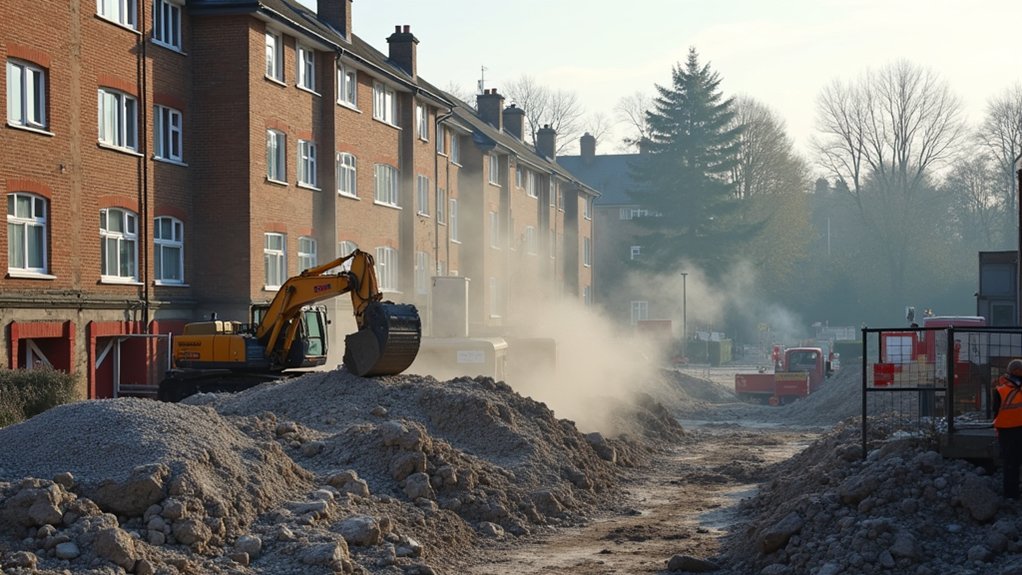
Although demolition looks like the fastest line item on a regeneration programme, the best outcomes come from rigorous front-end planning that protects ROI and programme certainty. You start with surveys (asbestos, utilities, structural), then build a quantified scope, method statement, and cost plan tied to phasing and logistics. You secure approvals, party-wall agreements, and stakeholder sign-off early to prevent delay premiums.
Next, you sequence enabling works: isolate services, install hoarding, set traffic management, and programme waste routes to hit landfill-diversion targets and stabilise disposal pricing. You embed Historical preservation via façade retention or salvage schedules that protect asset value and consent.
You also lock in Noise mitigation—monitoring, restricted hours, and low-impact techniques—to reduce complaints, stop-notices, and productivity loss. Finally, you execute soft strip, machine demolition, material segregation, and certified site clearance ready for construction start.
What Demolition Delivers: and What It Disrupts
Because demolition resets the site’s risk profile, it delivers immediate, quantifiable value—removing unsafe structures, eliminating asbestos liabilities, freeing footprint for surveys and piling, and releasing a clear start date that de-risks finance drawdowns and contractor pricing.
But it also disrupts the very conditions that protect programme certainty, from traffic and business access to utilities resilience, noise/vibration thresholds, and neighbour goodwill. All of these can translate into delay costs, claims exposure, and reputational drag if you don’t manage them as tightly as the physical clearance.
You’ll maximise ROI by sequencing isolations, logistics, and monitoring to keep critical paths intact.
Lock in Historical preservation early with surveys and salvage plans, so redesign doesn’t stall on late discoveries.
Use Community engagement to cut objections, compress approvals, and protect letting momentum.
Track KPIs: complaints per week, road occupancy hours, utility incidents, and variance to baseline programme.
Demolish or Retrofit: Carbon, Cost, and Programme
Clearance gets you a cleaner risk profile, but it also forces the next, higher-stakes decision: do you bank the speed and design freedom of demolition, or protect embodied carbon and often capex by retrofitting what’s already there?
You’ll weigh whole-life carbon alongside yield and lettability: new-build can cut opex via high-performance envelopes, lift rents, and de-risk compliance, but it front-loads carbon and financing.
Retrofitting and adaptive reuse typically shorten planning friction, preserve structure value, and reduce environmental impact, yet you may inherit constraints that limit net-to-gross, MEP upgrades, and future change-of-use.
Run scenarios: programme months saved versus interest carry; capex per m² versus achievable ERV; and carbon cost exposure under tightening UK reporting and investor screens.
You’ll choose the option that clears IRR hurdles without pricing in avoidable risk.
How to Demolish Responsibly (Community, Heritage, Circularity)
Where do you start if demolition still pencils out, but you can’t afford the reputational, planning, or ESG hit? You start with evidence: baseline embodied carbon, waste arisings, and a reuse target that lenders and planners can audit.
Build community engagement into the programme early—mapping stakeholders, publishing noise/dust logistics, and funding local jobs can cut objections and de-risk consent timelines.
Protect value with heritage preservation: commission a heritage impact assessment, salvage façade elements, and document materials for reuse to avoid costly redesigns.
Then design for circularity: pre-demolition audits, soft-strip sequencing, and take-back contracts typically lift recovery rates above 90% and reduce landfill tax exposure.
Track KPIs weekly and tie contractor incentives to recovery, safety, and schedule performance.
Frequently Asked Questions
How Do Demolition Projects Affect Local Council Tax and Business Rates?
Demolition can cut your council tax and business rates temporarily because reduced property value lowers tax assessment, then raise them after redevelopment. You’ll see short-term revenue dips, long-term ROI gains, depending on vacancy, timing, and revaluation cycles.
What Insurance and Liability Cover Is Required for Demolition Contractors?
Like walking a tightrope over rubble, you’ll need Insurance requirements: public liability, employers’ liability, contractors’ all-risks, plant/equipment, professional indemnity, and pollution/asbestos. You’ll secure liability coverage limits aligned to contract value, risk data, and lender ROI.
How Are Utility Diversions and Service Disconnections Coordinated and Funded?
You coordinate diversions via early surveys, joint design with utility owners, permits, and outage scheduling. You fund them through developer contributions, Section 106/CIL, and utility allowances—aligning Utility upgrades with funding mechanisms to protect ROI.
What Legal Remedies Exist if Demolition Causes Property Damage Nearby?
You can claim negligence, nuisance, trespass, or statutory breach; pursue injunctions and damages. Establish Legal liability with survey evidence and expert reports. Use insurers, ADR, or court. Follow compensation procedures to recover repair costs, loss, and fees.
How Can Residents Track Demolition Compliance, Permits, and Enforcement Actions?
You can track compliance by checking council planning portals, permit registers, and enforcement logs, using Digital monitoring alerts, FOI requests, and site inspections. Join Community engagement groups to flag breaches faster, reducing risk and protecting property value.