
 By DQCS
When you source stone for concrete, asphalt, or base course, you’re really buying predictability—tons on spec, on time, at the lowest delivered cost. That starts long before the first blast, with geology, permits, and a site plan that keeps haul distances short and compliance risk low. Then you control fragmentation, crushing, and screening to reduce waste and downtime. But the biggest cost lever isn’t where you think it is…
From Geologists to Permits: Choosing a Quarry Site

Where do you start if you want a quarry that pays off instead of bleeding cash? You start with geologists who can prove the reserve: rock quality, thickness, overburden, and variability. You run sampling and lab tests to estimate yield, processing needs, and saleable products.
Then, you model haul distance, power access, water, and trucking bottlenecks that kill margins. Next, you screen sites for Environmental impact early—setbacks, runoff control, habitat constraints, and reclamation costs belong in your pro forma, not your surprises.
You also budget for community engagement: meet neighbors, address dust and traffic, and document commitments before opposition hardens. Finally, you map the permit path, timelines, and legal risk so your capital doesn’t sit idle.
Blasting and Cutting: How Stone Extraction Works
Once you’ve proved the reserve and cleared the permit path, the next profit-or-loss decision is how you’ll get rock out of the ground. If you pick Explosive techniques, you’ll trade drill-and-load costs for fast advance. You control ROI by dialing burden, spacing, and timing so you loosen rock without excess flyrock, overbreak, or rework. Tight blast design cuts wall damage, reduces scaling time, and protects haul roads and benches.
If you choose Cutting machinery—wire saws, chain saws, or surface miners—you’ll pay more per hour but gain predictable fragmentation, cleaner faces, and quieter operations that can extend working windows. You’ll also lower vibration risk near structures, trimming monitoring and claims.
In either method, track downtime, energy use, and consumables daily, and standardize procedures to keep extraction costs stable.
Crushing and Screening: Turning Rock Into Aggregates
After you’ve freed the rock from the face, your margins hinge on how efficiently you crush and screen it into saleable sizes. You start by choosing crushing technology that matches your feed: a jaw for primary reduction, cones or impacts for shaping, and a closed circuit to keep oversize from leaking into finished piles.
You tune settings, liner profiles, and speed to cut recirculating load, lower kWh per ton, and extend wear-part life.
On the screening side, you manage moisture, deck selection, and stroke so fines don’t blind the media and stall throughput. You separate products cleanly to minimize rehandling and double processing.
When you control breakage and limit flaky particles, you protect aggregate durability while still pushing tons per hour and protecting cash flow.
Quality Control: Spec Stone for Concrete and Asphalt
Although your plant can hit the right gradation all day, you don’t make real money unless every load meets concrete and asphalt specs without callbacks or price deductions. Build QC into your shift, not as a paperwork chore. Calibrate scales, verify moisture, and run Density testing on stockpiles so you control compactability and binder demand.
Use chemical analysis to flag alkali-reactive silica, deleterious fines, or sulfate risks before they reach the batch plant or paver. Track LA abrasion, soundness, and flat/elongated limits against each job’s spec, then adjust crusher settings and screening decks immediately.
Keep tight sampling frequency and document results, because fast corrective action protects your margins, shortens disputes, and keeps premium contracts coming.
Hauling and Impacts: Logistics, Dust, and Reclamation
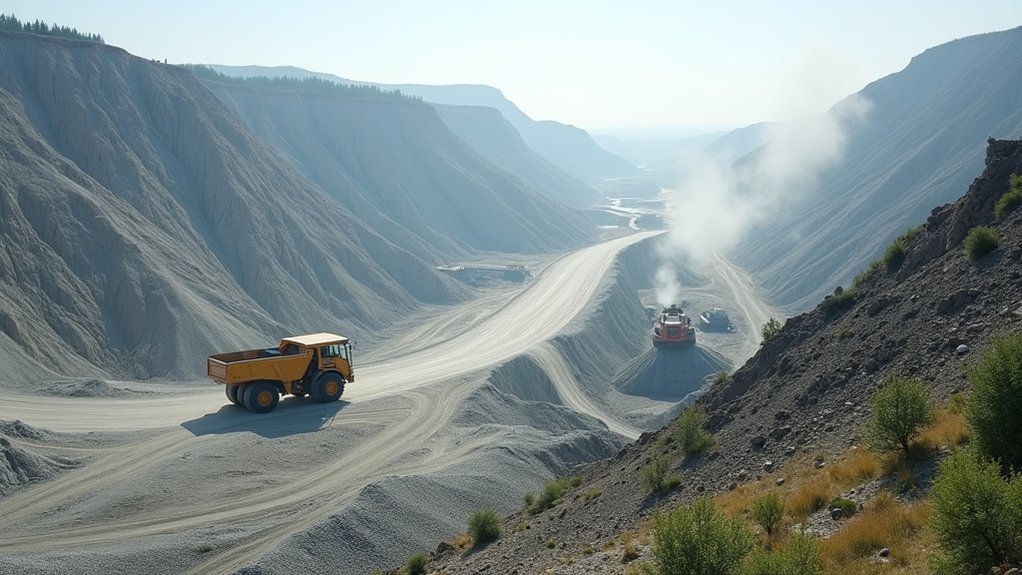
Because hauling eats margin faster than any crusher tweak, you’ve got to run logistics, dust control, and reclamation like profit centers—not afterthoughts.
You cut cost per ton by tightening dispatch, backhauling where possible, and matching truck size to route grades and loading cycles. You reduce idle time with staged stockpiles, fast scale tickets, and predictable turnarounds that keep carriers loyal and rates lower.
You also protect uptime by treating dust as lost product and risk: spray bars, enclosure skirts, and paved high-traffic lanes slash cleanup, complaints, and equipment wear.
Track Environmental impact with monitors and documented SOPs, then pair them with community engagement—clear blasting notices, truck-route commitments, and prompt response.
Reclamation starts now: segregate topsoil, contour benches, seed quickly, and close out bonds faster.
Frequently Asked Questions
What Careers Exist in Quarry Operations Beyond Equipment Operators?
Beyond operators, you can work as a site supervisor, mine planner, maintenance tech, quality control, surveyor, or logistics lead. Like Atlas, you’ll manage Mining safety and environmental impact, cutting downtime, waste, and compliance costs.
How Do Quarry Stones Influence Architectural Aesthetics and Interior Design?
You shape aesthetics by choosing quarry stone texture and color palette to set mood, scale, and luxury cues. You’ll boost ROI by specifying durable finishes, minimizing cuts and waste, and matching local supply to budgets.
What Insurance Coverage Do Quarry Companies Typically Need?
You typically need insurance policies like general liability coverage, workers’ comp, commercial auto, equipment breakdown, environmental/pollution, and umbrella. You’ll cut costly downtime, meet contract requirements, protect cash flow, and reduce claim-driven premium spikes.
How Do Aggregate Prices Fluctuate With Regional Construction Demand?
Aggregate prices rise when your region’s construction demand spikes and fall when projects slow. You’ll track Market trends and Pricing factors like fuel, haul distance, plant capacity, and supply constraints to time purchases.
Can Recycled Aggregates Fully Replace Quarried Stone in Modern Projects?
No, you can’t fully replace quarried stone yet—measure twice, cut once. Recycling limitations affect strength and grading; still, you’ll cut hauling costs and environmental impacts by blending recycled aggregate where specs allow.