
 By DQCS
On a mid-rise infill project in Denver, you switch from a porous limestone veneer to a tighter-grain granite after freeze–thaw testing flags spalling risk. That single call protects your schedule, reduces callbacks, and stabilizes lifecycle cost, even if unit pricing rises. When you set performance criteria upfront—structure vs veneer, exposure, finish, and quarry lead times—you control waste and change orders. The next step is where most budgets quietly slip…
Define Your Stone Selection Criteria First

Before you compare granite to limestone or weigh one finish against another, lock in the criteria that actually drive performance and cost on your project. Start with exposure: freeze-thaw, deicing salts, UV, foot traffic, and cleaning chemicals. Translate each into measurable specs—absorption, density, abrasion resistance, slip rating, and required sealer cycles—so bids stay comparable and maintenance stays predictable.
Define acceptable Stone texture ranges for traction and visual intent, and set tolerances for color consistency across lots to avoid costly mockup rework and field sorting. Confirm lead times, minimum order sizes, and waste factors tied to panel sizes and cutting yields.
Then document test standards and submittal requirements up front so you’re paying for verified performance, not assumptions.
Choose Stone Selection for Structure vs Veneer
You’ll get the best ROI when you choose stone based on whether it must carry loads or simply cover a wall.
For load-bearing work, you’ll prioritize strength, consistent density, proper sizing, and proven durability.
For veneer, you’ll focus on weight, anchoring compatibility, weather resistance, and finish stability.
Because structural stone drives engineering, labor, and detailing costs while veneer shifts spend to substrates and attachment systems, you should price both assemblies—not just the stone—to compare true installed cost.
Load-Bearing Stone Criteria
Because the stone’s role drives almost every cost and performance decision, you’ll get better ROI by deciding upfront whether you need true load-bearing masonry or a non-structural veneer.
If it’s load-bearing, you must prioritize compressive strength, unit consistency, and tested performance over Natural aesthetics alone, then validate Material compatibility with mortar, backup walls, and any steel anchors to avoid costly cracking or corrosion.
Specify ASTM/EN-rated stone, require mill certificates, and match density and absorption to your climate exposure.
Control tolerances: bed height, squareness, and face finish affect course alignment and labor hours.
Confirm wall thickness, bond pattern, and grout strategy meet code and engineer loads.
Finally, plan handling: piece size, lifting points, and staging can make or break install productivity and schedule.
Veneer Stone Performance Factors
Load-bearing stone puts strength first; veneer shifts the ROI math toward durability, moisture control, and installation efficiency. You’ll prioritize a reliable rainscreen approach: compatible WRB, flashings, weeps, and a defined drainage plane to prevent freeze-thaw damage and callbacks.
Specify anchoring or mortar systems tested for your substrate, wind loads, and expected movement, then demand shop drawings and mockups to lock in details.
Manage Color consistency by confirming batch ranges, preblending pallets, and setting acceptance criteria under site lighting.
Use Texture variation intentionally: too much can hide layout errors, while too little shows repeating patterns and patch repairs.
Finally, verify absorption rates, salt resistance, and sealant compatibility so the façade performs without constant touch-ups. Over time.
Structural Versus Veneer Costs
While stone can look identical on the surface, structural and veneer assemblies behave like two different budget lines: structure demands thicker units, engineered bearing details, and heavier foundations, while veneer lets you buy aesthetics and durability without paying for the full structural stack.
For a clear Cost comparison, price the whole system: stone thickness, anchors, lintels, reinforcing, cranes, and schedule impacts. Structural stone often triggers higher insurance, longer lead times, and more QA testing, but it can reduce façade maintenance and boost fire and impact resistance.
Veneer usually wins on installed cost and speed, especially over steel stud or CMU backup, and it improves thermal control when paired with continuous insulation.
Let aesthetic considerations guide where you spend: reserve full-depth for high-wear zones; veneer everywhere else to protect ROI.
Match Stone Selection to Climate and Exposure
You’ll get better ROI when you match stone durability to your climate—freeze–thaw cycles, salt spray, heat, and driving rain can crack or stain the wrong choice fast.
You should specify exposure-rated stone and pick finishes that fit the site, since rough or porous surfaces trap moisture while polished or sealed options can reduce absorption and maintenance.
If you align stone type, density, and finish with actual weather and exposure zones, you’ll cut callbacks, extend service life, and protect your budget.
Climate-Driven Stone Durability
Because climate dictates how quickly stone weathers, you’ll get a far better ROI when you match your stone’s porosity, mineral makeup, and finish to the exact exposure it’ll face—freeze–thaw cycles, salt spray, acid rain, wind-driven grit, and persistent moisture.
Start by mapping local Weathering patterns: spalling at edges, sugaring on soft limestones, rust staining from iron-rich stones, or scaling under de-icing salts.
Then check lab data—absorption, density, compressive strength, and sulfate resistance—and select stone that stays stable at your site’s wet/dry rhythm.
In big temperature swings, prioritize low-porosity, tight-grained stones that resist Thermal expansion stress and microcracking.
In coastal or industrial zones, favor siliceous stones with minimal calcite to limit chemical attack.
You’ll cut repairs, reduce warranty risk, and extend service life.
Exposure And Finish Selection
Once you’ve nailed the right stone for your climate, the exposure category and finish decide whether it performs—or turns into a maintenance line item. Start by mapping where it’ll live: coastal salt spray, freeze-thaw splash zones, high-UV façades, or interior low-wear areas.
For heavy exposure, choose dense, low-absorption stone and a Surface treatment that boosts slip resistance and limits staining without trapping moisture. In splash zones, skip highly polished faces; they show etching, algae, and de-icing damage fast.
For sunny elevations, prioritize Color consistency across lots so replacements don’t telegraph repairs and depress resale value. Specify mockups, sealing intervals, and acceptable variation in the spec.
You’ll cut callbacks, extend service life, and protect your margins on every elevation.
Compare Granite vs Limestone vs Sandstone
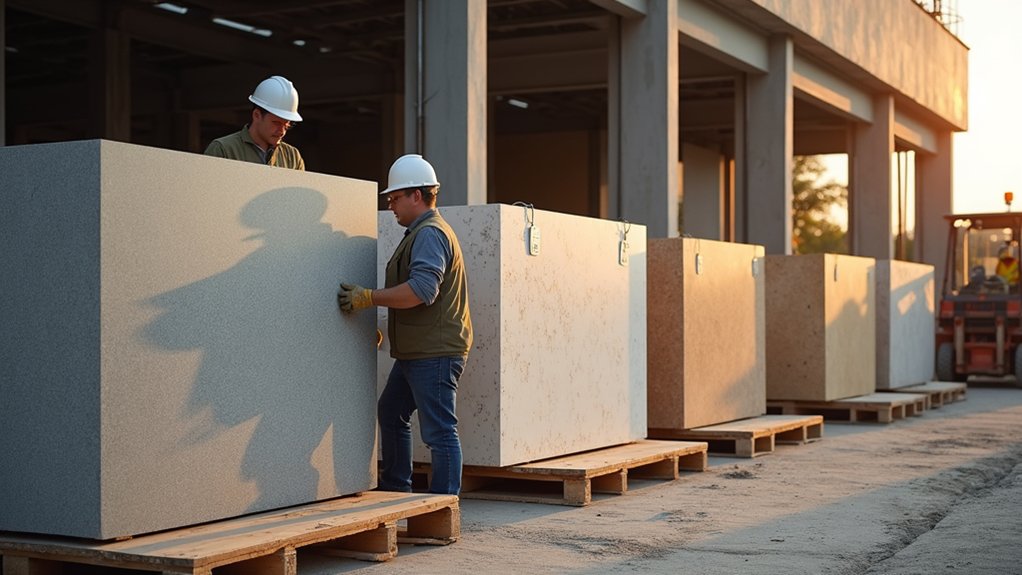
Where does the ROI really land when you’re choosing between granite, limestone, and sandstone for a modern build? You’ll see it in lifecycle costs: replacement risk, maintenance hours, and performance under wear.
Granite durability delivers the strongest payback for high-traffic flooring, stairs, and exterior cladding; it resists scratching, heat, and freeze-thaw, so you budget less for repairs and resealing.
Limestone aesthetics can lift perceived value in lobbies and façades, but you’ll spend more managing etching and staining, especially near kitchens, fountains, or polluted streets.
Sandstone often sits between them on price and maintenance; it’s workable and warm-looking, yet it can delaminate or erode if you place it in harsh exposure.
Match stone to use, not just taste.
Quarry to Site: Stone Supply Chain Steps
ROI doesn’t stop at picking granite, limestone, or sandstone—it also depends on how reliably that stone moves from quarry to your site without surprises that trigger change orders. You protect margin by validating quarry capacity, lead times, and block yield before you approve samples, then confirming Mining regulations won’t stall extraction or loading.
Next, you lock specs into a quarry cut list, assign lot tracking, and require photos, measurements, and test reports per shipment.
You reduce waste by coordinating saw schedules with fabrication slots and packing plans, so crates match lift points and staging areas.
Finally, you de-risk arrivals by mapping transportation logistics: permits, axle limits, port windows, customs docs, and last-mile access. You schedule buffers for weather and inspections, and you verify delivery sequences align with your pour and envelope milestones exactly.
Estimate Stone Selection Cost: Install to Upkeep
How do you estimate what a “good” stone choice really costs—from install day through year-10 upkeep? Start with installed cost per square foot, then add labor complexity: cut tolerances, anchoring, edge finishing, and access equipment. Price waste too; irregular slabs can push overage from 5% to 15%.
Next, model maintenance: sealing cycles, cleaning chemistry, repointing, and freeze-thaw repairs. Assign annual dollars and discount them, so you compare real lifecycle cost, not sticker price.
Track performance risks: softer stones chip, polished surfaces show etching, and light colors stain—each hits operating budget.
Finally, weigh payback: stone with Historical significance and lasting aesthetic appeal can lift rents, sales velocity, and tenant retention, offsetting higher upfront spend.
Specify Stone Selection for Codes and Sustainability
Before you lock in a stone, run it through the same filter you’d use for any high-stakes spec: code compliance plus measurable sustainability outcomes that protect budget.
Verify ASTM/EN test data for compressive strength, freeze-thaw durability, slip resistance, and fire rating, and match it to occupancy, egress, and facade anchorage requirements.
If you’re in a seismic or high-wind zone, require engineer-stamped attachment details and mockups to avoid change orders.
For sustainability, request EPDs, recycled content, and quarry water/energy metrics; favor regional sourcing to cut transport emissions and lead times.
Document chain-of-custody and maintenance plans to meet LEED or local green codes.
In Historical preservation work, confirm compatibility, color range, and finish so aesthetic considerations stay intact.
Frequently Asked Questions
How Do I Clean and Remove Graffiti From Natural Stone Surfaces?
Start with gentle Graffiti removal: test a pH-neutral natural stone cleaning detergent, soft brush, and warm water. If needed, use a stone-safe solvent poultice, rinse well, seal afterward, and avoid acids or pressure washing.
Can I Mix Multiple Stone Types on One Facade Without Visual Conflict?
Yes, you can—like pairing a tailored jacket with jeans. You’ll avoid conflict with Color coordination and smart Texture blending. Limit to 2–3 stones, match undertones, repeat accents, and sample panels to cut costly rework.
What Are the Best Sealers for Stone, and How Often Should I Reseal?
You’ll get best ROI with penetrating silane/siloxane or fluoropolymer sealers; use enhancing only for color. Sealant durability depends on exposure: reseal 1–3 years exterior, 3–7 interior. Follow Sealer application techniques: clean, dry, thin coats.
How Does Stone Selection Affect Indoor Air Quality and Occupants’ Health?
Choose low-emitting stone, and you’ll breathe cleaner air; choose porous, contaminated stone, and you’ll trap Indoor air pollutants. Specify tested, sealed materials to protect occupant health, cut absenteeism, and reduce HVAC cleaning, maintenance, and liability.
Can Damaged Stone Be Repaired Invisibly, or Must It Be Replaced?
You can often repair damaged stone invisibly, but you’ll replace it when cracks run deep, spalling spreads, or structure fails. Stone repair plus color-matched fillers, pinning, and honing improve Damage invisibility and ROI.